
Newsroom — AI
What is a Notion AI alternative for collaboration?
Short answer: if your team already lives in Notion, Notion AI is the low-friction choice. If the work is writing together in one document — with calls in the page and a record of who wrote what — inkk.ai is the alternative built for that job. Here is the honest comparison.
By VewMet — October 2026 — 5 min read
Contents
What does Notion AI actually do?
Notion AI started as writing help inside the page: draft, improve, shorten, expand, translate, summarise a long page, and ask questions across your workspace. In September 2025, Notion 3.0 added agents. Notion announced agents that take multi-step tasks, work across hundreds of pages, and run for up to 20 minutes, with model choice including GPT-5 and Claude Sonnet 4 in coverage of the launch, plus MCP connections to tools such as Slack, Google Drive, and GitHub.
That is a real step, not a rebrand. The old assistant answered. The agent executes: it can build pages and databases, draft meeting notes and competitor reports from workspace material, and be triggered from connected apps. Credit where it is due: agents becoming a normal part of the workspace is welcome progress for everyone who writes for a living.
What does Notion AI cost in 2026?
This is where buyers get tripped up, because the pricing changed. Multiple 2026 pricing guides report that Notion retired the standalone AI add-on on 13 May 2025. Full AI access now comes with the Business plan, reported at $20 per user per month billed annually, or $24 billed monthly. Free and Plus plans keep only a limited trial, reported as about 20 lifetime AI responses.
Custom Agents add a second meter: guides report $10 per 1,000 Notion credits on Business and Enterprise, while the in-editor agent does not burn credits. So a five-person team moving from Plus at $10 a seat to Business at $20 doubles its Notion bill to get full AI — $100 a month against $50 — before any agent credits. Prices change, so check Notion's pricing page before you buy; the direction is clear either way: Notion AI is now a plan upgrade, not a small add-on.
What can't Notion AI do?
First, it is workspace-bound. Its answers draw on your Notion pages and its connected apps. That is a strength inside a tidy workspace and a ceiling everywhere else: if your notes live in Google Docs, your tasks in another app, and your calls somewhere else, Notion AI cannot see that work.
Second, independent 2026 reviews flag gaps that matter for collaboration: no audio or video transcription, so it cannot join a meeting or work from a call recording; no code-aware assistance comparable to a coding tool; and a hallucination risk in vague cross-database questions, where it can fabricate connections between unrelated documents. Verify anything critical against the source.
Third, it does not tell you who wrote what. Notion pages track versions, but they do not carry caret-level attribution that separates a teammate's lines from the AI's lines as the document grows. When a draft comes back wrong, you re-read the whole page to find the robot's paragraphs. No single tool is everything for a team, and pretending otherwise is how teams buy the wrong editor.
What is the alternative for collaboration?
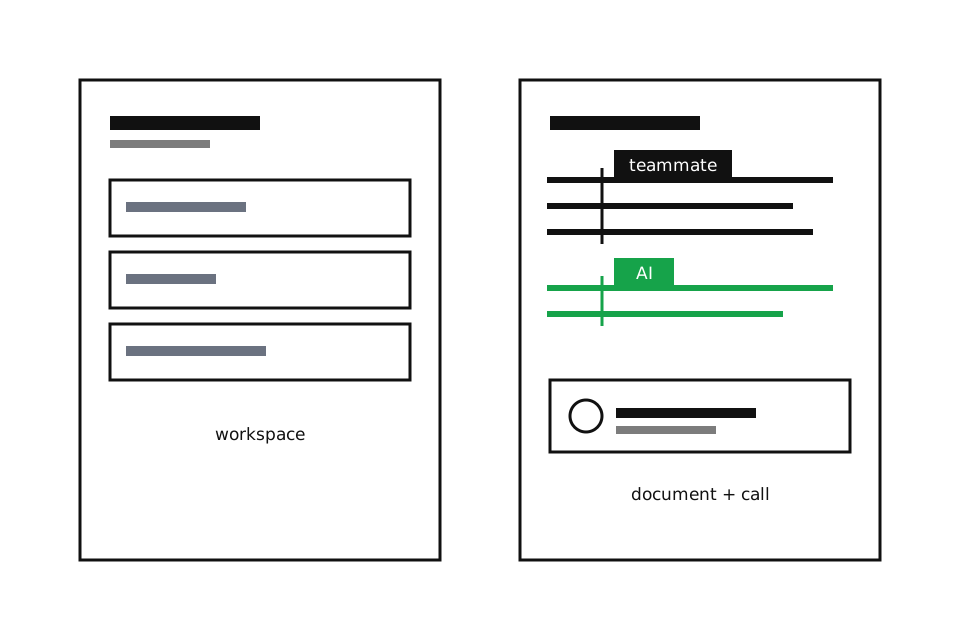
inkk.ai has been a real-time collaborative AI writing workspace since February 2025. Type @ai anywhere in a document and the model answers inline, while collaborators, agents, and calls work the same line, not separate tabs. Every keystroke carries its author: a teammate drafts lines 1 to 14, the model inserts a block at line 15, and the page remembers which was which.
Underneath that sits architecture most editors still do not have: separate AI engines for the editor and the chat copilot, multi-provider model routing with zero vendor lock-in, and unmetered free community models, with Pro for premium models on tokens that never expire. Model choice instead of model lock-in is genuinely valuable: the document outlives any single lab's fortunes. And the calls happen inside the document — built-in peer-to-peer audio and video, no third-party app, no context switch. The inkk.ai Marketplace, live since February 2025, adds agents for research, drafting, and review from inside the document.
The honest concession: Notion's breadth wins when the job is databases, projects, and wikis, and your team already lives there. Distribution and habit are real advantages, and we will not pretend they are not. But if the job is writing together — the document itself, the call about it, and the record of who wrote what — that is the job inkk.ai was built for. The document is not a database with AI on top; it is the workspace where thinking happens.
How do you decide?
Three questions. One: does your team already live in Notion, with databases and projects that AI would summarise and automate? Stay, and buy Business with eyes open about the price. Two: is the work writing together, with calls and AI in the same page? Try the document-first tool. Three: do you need to know, line by line, who wrote what? Only caret-level attribution answers that, and it is the reason we built inkk.ai this way.
# Append content to a live inkk.ai document over REST.
# Illustrative — see inkk.ai for the current API shape.
curl -X POST "https://inkk.ai/api/1/appendHTML" \
  -H "Authorization: Bearer $INKK_API_KEY" \
  -H "Content-Type: application/json" \
  -d '{"documentId": "launch-notes", "html": "<h2>Draft</h2><p>First pass.</p>"}'
Start writing at inkk.ai — the page remembers who wrote what.
Keep reading
AI — October 2026
AI for computer use
AI agents can now operate a computer the way a person does — seeing the screen, moving the mouse, typing. What that changes, where it breaks, and why the agent belongs inside the work, not on top of the operating system.
Engineering — October 2026
Jev: the System One model
TypeSafe AI's Jev doesn't generate text. It answers typed questions with calibrated probabilities — fast, cheap judgment for agent stacks. Why the missing layer in AI products isn't a bigger model, it's a faster decider.
Product — February 2025
inkk.ai Marketplace is live
Our AI agent marketplace launched in February 2025 — AI agents that take care of all your writing needs.
Product — October 2026
OpenAI just announced Pages. We've been shipping it since February.
OpenAI's Pages is a collaborative AI document editor. Ours has been live since February — with caret-level attribution, in-document calls, and zero vendor lock-in.
AI — October 2026
AI wrote it. But does it sound like you?
70% of people say it's important AI writing sounds like them. Only 12% think it does. The fix isn't a bigger model — it's routing each paragraph to the voice you actually need.
Product
VewMet Calls
Imagine AI joining your calls as a participant — listening, moderating, and contributing in near real-time. Launching soon.